Let’s Start with the Honest Bit
Most people stumble upon SIF Investment the same way they stumble upon anything financial: by accident. Maybe a friend dropped the term at a dinner table, or a relationship manager at your bank casually tossed it in while you were nodding along, pretending to understand. It happens. And honestly? That’s fine. Because the concept, once you peel back the jargon, is genuinely interesting and worth understanding properly rather than just nodding along forever.
So, let’s slow down and actually unpack this thing together.
Okay, So What Even Is SIF?
SIF stands for Specialised Investment Fund. Now, here’s the thing: the “specialised” part is doing a lot of heavy lifting in that name. Because, unlike your regular mutual fund or a plain vanilla SIP setup, a SIF is designed for a very specific kind of investor, someone who’s a little more experienced, a little more risk-aware, and frankly, someone who’s willing to put a significantly larger amount on the table to begin with.
Read More : Managing Investment Portfolio Balance for Long-time Success
Think of it this way. If a regular SIP is like buying a good quality meal at a well-known restaurant, an SIF investment is more like commissioning a private chef. The ingredients might overlap, but the access, the customisation, and the price point? Totally different ballgame.
Where Did This Come From?
Good question. SIFs, as a formal structure, emerged from the need to bridge a gap. On one end, you had retail mutual funds, highly regulated, accessible, designed for everyone from a college student with five hundred rupees to a salaried professional with modest monthly savings. On the other end, you had Portfolio Management Services and Alternative Investment Funds, heavy-ticket, exclusive, and built for high-net-worth individuals who basically sneeze money.
There was this middle ground, a big chunk of investors who were neither newbies nor ultra-wealthy, who wanted something more sophisticated than a retail fund but couldn’t quite meet the crore-plus minimums of AIFs. SIF investment was introduced as a structured way to serve exactly that audience.
Hold on, Let Me Think About That for a Second
Because this is where it gets interesting, and also where people tend to get confused. And the answer is: sort of, but not quite.
A regular mutual fund, especially one accessed through a SIP route, pools money from thousands of investors. Thousands. Your five thousand rupees sits alongside someone else’s two lakh rupees, and together they form a giant corpus that a fund manager then deploys across equities, debt, or a mix of both. The regulatory framework is tight, the disclosures are frequent, and the liquidity is generally good.
A SIF, on the other hand, operates with more flexibility. Fund managers in this space can pursue strategies that aren’t typically available in retail products. We’re talking about long-short positions, derivatives-based strategies, concentrated bets, sector-specific plays that go well beyond what a standard diversified equity fund can do. More rope. More risk. Potentially more reward. But definitely not something you want to walk into without knowing what you’re signing up for.
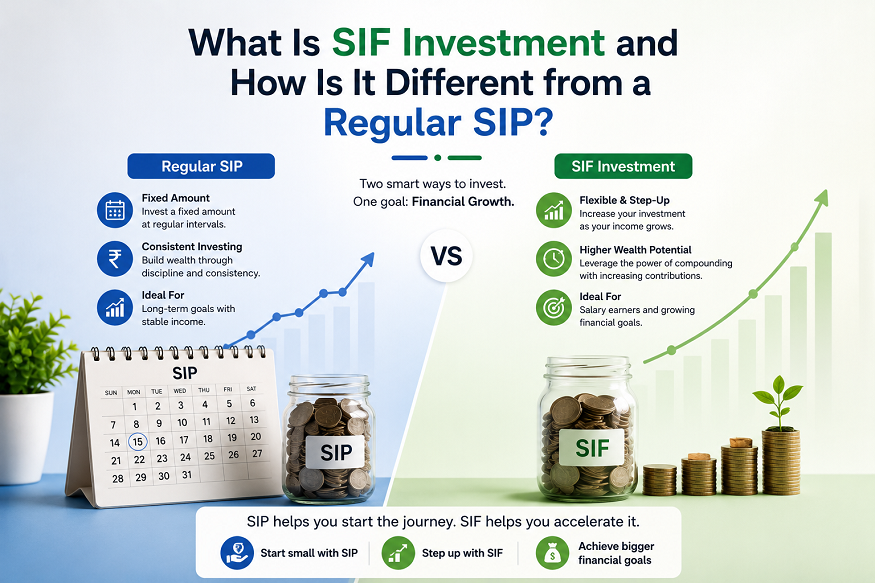
The SIP Comparison, Side by Side
Now, when people ask how this compares to a regular SIP, they’re essentially asking two different questions bundled into one. The first is a structural question: how does a SIF work versus a SIP? The second is a suitability question: which one is actually right for me?
Let’s tackle structure first.
A SIP, or Systematic Investment Plan, is a method of investing, not a product in itself. Five thousand, ten thousand, whatever fits your budget. The magic is in the consistency and the compounding over time. Simple. Elegant. Accessible.
A SIF is the product. The whole thing. You don’t set up a SIP into an SIF the same way you’d set up a SIP into an equity fund. The ticket sizes are larger, the investor eligibility criteria are stricter, and the investment mandate is far more nuanced. You’re committing capital to a strategy, not just dripping money in month by month.
That said, some SIF structures do allow systematic commitments over time, but it’s not quite the same breezy process of logging into an app and clicking “start SIP.”
Who’s It Actually For, though?
Here’s where you need to be really honest with yourself. SIFs are typically designed for investors who meet a higher net-worth threshold, who understand market risk beyond the basics, and who are comfortable with the idea that liquidity might not be instant. You can’t just panic-sell on a bad Monday morning the way you might redeem mutual fund units.
If you’re just starting, or if your investment horizon is short, or if the thought of market fluctuations keeps you up at night already, a standard SIP into a well-diversified fund is probably your best friend right now. No shame in that. Seriously. The boring, consistent monthly SIP has quietly created more millionaires than most exotic strategies ever will.
But if you’ve already built a reasonable corpus, if you understand what a derivatives overlay means, if you’re looking for return potential that goes beyond what traditional funds offer, and if you have the risk appetite to match, then exploring this category makes genuine sense.
The Regulatory Side of Things
It’s also worth knowing that SIFs in India operate under a distinct regulatory framework, one that sits between retail mutual funds and full-blown alternative investment vehicles. The oversight is real and meaningful, but the rules are looser than what governs your typical equity or debt mutual fund. This is intentional. The flexibility is the point.
This also means that you need to read the fine print. Carefully. The offer documents for these products are not light bedtime reading. They’re dense, they’re technical, and skimming them is genuinely risky. If the documentation feels overwhelming, that’s actually a signal worth listening to.
What About Returns?
Now we’re getting to the part everyone actually cares about. Will a SIF give you better returns than a regular SIP?
Honest answer: maybe. Possibly. Under the right conditions, with the right strategy, with the right manager at the helm, yes, these products can deliver alpha that outpaces conventional funds. But that word “can” is doing a lot of work in that sentence. More flexibility means more opportunities to get it right, and also more opportunities to get it spectacularly wrong.
A regular SIP, plugging away into a decent index fund or a proven actively managed fund over ten or fifteen years, has a strong, well-documented track record. It’s not flashy. It won’t give you a story to tell at dinner parties. But it works.
So, Which One Wins?
Neither. That’s the genuinely useful answer here, even if it’s a bit unsatisfying. These aren’t competing products in a winner-takes-all match. They serve different purposes, different investor profiles, and different stages of a financial journey.
Read More : What to Expect from a Professional Utah Asphalt Contractor
If you’re reading this and wondering whether to ditch your SIP for something fancier, the answer is almost certainly: keep the SIP. Add complexity only when your financial foundation is solid enough to support it. Specialised investment funds are built for capital that can afford to be patient and strategic, not for savings that need to stay accessible and stable.
Wrapping It Up Without Getting Preachy
Look, financial products are only as good as the understanding behind them. A SIP works brilliantly for millions of people precisely because it’s simple, consistent, and hard to mess up. Specialised investment funds, on the other hand, are powerful tools in the right hands, but they demand a level of financial fluency that not everyone has yet, and that’s completely okay.
The smartest thing you can do is know where you currently stand, be honest about your risk tolerance and your knowledge gaps, and then make choices that actually match your reality rather than the version of yourself you imagine you’ll be someday.
Start where you are. Build from there. And if a SIF ever becomes the right fit for you, you’ll know it when the time comes.
About the Author